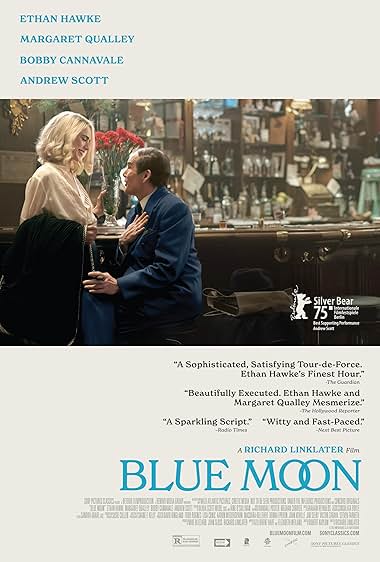

Tells the story of Lorenz Hart's struggles with alcoholism and mental health as he tries to save face during the opening of "Oklahoma!".Tells the story of Lorenz Hart's struggles with alcoholism and mental health as he tries to save face during the opening of "Oklahoma!".Tells the story of Lorenz Hart's struggles with alcoholism and mental health as he tries to save face during the opening of "Oklahoma!".
- Director
- Writers
- Stars
- Awards
- 3 wins & 7 nominations total




Robert Kaplow
- Radio Announcer
- (voice)
- Director
- Writers
- All cast & crew
- Production, box office & more at IMDbPro
7.05.9K
1
2
3
4
5
6
7
8
9
10
Featured reviews
Ultimately Tiresome Tour De Force
Ethan Hawke really gets to show off his theater chops in what's essentially a one-man show about Broadway lyricist Lorenz Hart, trying to remain relevant to any who'll listen one night in 1943 at Sardi's. But despite the witticisms and urbanity Hawke is essentially one-note in his patter, and you eventually start to feel like Sarah Connor's dream in T2, clinging to a chain-link fence and being flailed to the bone by his nuclear, non-stop desperation. It's nice he and Linklater have a longtime devotion to each other and have stretched out into this new territory for their as always dialogue-heavy collaborations, but you'll be heading to the bar for some welcome cirossis long before little Lorenz corners you with his next needy, horrifying salvo of yammering.
One night at Sardi's
Blue Moon
You saw me standin' alone
Without a dream in my heart
Without a love of my own
Ethan Hawke makes himself almost unrecognizable to play Lorenz Hart, the man who wrote those words.
Hart was five-feet tall, balding, a cigar always in his mouth, his back so curved his chin barely clears the bar at Sardi's where he spends most of the movie "Blue Moon" yakking away. His sad - if witty and sometimes brilliant - monologues are performed for bartender Eddie (Bobby Cannavale), piano player Knuckles (Jonah Lees) and assorted folks who stop by the legendary Broadway celebrity hangout one fateful night in 1943.
Showcasing the alcoholism and other sorts of self-destructiveness that would kill him at age 48 seven months later, it's a daring, all-in performance by Hawke. It's already getting buzz this awards season.
Whether or not it nabs an Oscar nomination or two, it won't win many hearts in audiences looking for a fun night out at the movies.
With composer Richard Rodgers providing the melodies, Lorenz Hart penned the sophisticated lyrics of countless Great American Songbook staples. Along with the movie's title tune, there was "Bewitched, Bothered and Bewildered." "My Romance." "Manhattan." "My Heart Stood Still." "The Lady Is a Tramp." And on. And on ... close to a thousand songs.
For two decades Rogers and Hart were a dynamic duo on Broadway and Hollywood. Piano bar songs on the soundtrack offer nonstop tribute to their musical glories, with echoes of contemporaries like the Gershwins, Cole Porter, Harold Arlen, Irving Berlin and even George M. Cohan.
Unfortunately, Robert Kaplow's script doesn't immortalize Lorenz Hart for all his achievements, but instead, for being the man who didn't write "Oklahoma!" Richard Linklater is once again Ethan Hawke's go-to director, confining the film's action essentially to one set, unfolding in something like real time on the night of March 31, 1943. For America, in those uncertain early years of World War II, that was the night "Oklahoma!" opened on Broadway and changed everything.
Rodgers and Hart were still a team when they began adapting the play "Green Grow the Lilacs" into a musical. Unfortunately, Hart's habit of going on weeks-long benders instead of showing up for work finally pushed Rodgers to his breaking point. As luck would have it, another lyricist was available. His name was Oscar Hammerstein II.
The rest, as they say, would become history, not just on Broadway but on community theater and high school stages to this day.
Lorenz Hart was in the audience for "Oklahoma!'s" opening night. But the corn as high as an elephant's eye, not to mention the dancing cowboys and the exclamation mark at the end of the title were more than his urbane Manhattan sensibilities could take. So he retreated to Sardi's for some lubricated self-pity an hour before the creators of the show, along with adoring first nighters would arrive to await the reviews.
Those reviews proved to be raves, hardly a recipe for improving Lorenz Hart's state of mind. His conversations with Richard Rodgers (Adam Scott), basking in triumph, are heartbreaking.
Among all the self-deceptions Hart concocts to help make it through the night, is his torrid passion for Elizabeth Weiland (Margaret Qualley), an aspiring stage artist and daughter of the president of the theater guild. Half his age and his devoted protege, her final admission that she doesn't have those feelings for him is just one more knife in the heart.
The fact that Hart was, in fact, gay in those closeted times certainly wouldn't do much to change those feelings on Elizabeth's part. But when he confides to Richard Rodgers that he is in love with her - "everyone is" - he speaks from the heart.
Insecurities, self-doubt and fear are as integral to the creative process as the exhilaration and joy of success. Hawke's portrayal uniquely illustrates the torture not of a has-been, but of what could have been.
Following last year's brilliant Bob Dylan biopic "A Complete Unknown," "Blue Moon" is a reminder that creative genius is not something that a handful of people possess ... but something more akin to a curse that possesses them.
Lorenz Hart was a lover of love, an appreciator of beauty, a chaser of make-believe. Unfortunately, the ability to find perfect words for these wonderful emotions doesn't translate into finding them in real life.
Ethan Hawke makes himself almost unrecognizable to play Lorenz Hart, the man who wrote those words.
Hart was five-feet tall, balding, a cigar always in his mouth, his back so curved his chin barely clears the bar at Sardi's where he spends most of the movie "Blue Moon" yakking away. His sad - if witty and sometimes brilliant - monologues are performed for bartender Eddie (Bobby Cannavale), piano player Knuckles (Jonah Lees) and assorted folks who stop by the legendary Broadway celebrity hangout one fateful night in 1943.
Showcasing the alcoholism and other sorts of self-destructiveness that would kill him at age 48 seven months later, it's a daring, all-in performance by Hawke. It's already getting buzz this awards season.
Whether or not it nabs an Oscar nomination or two, it won't win many hearts in audiences looking for a fun night out at the movies.
With composer Richard Rodgers providing the melodies, Lorenz Hart penned the sophisticated lyrics of countless Great American Songbook staples. Along with the movie's title tune, there was "Bewitched, Bothered and Bewildered." "My Romance." "Manhattan." "My Heart Stood Still." "The Lady Is a Tramp." And on. And on ... close to a thousand songs.
For two decades Rogers and Hart were a dynamic duo on Broadway and Hollywood. Piano bar songs on the soundtrack offer nonstop tribute to their musical glories, with echoes of contemporaries like the Gershwins, Cole Porter, Harold Arlen, Irving Berlin and even George M. Cohan.
Unfortunately, Robert Kaplow's script doesn't immortalize Lorenz Hart for all his achievements, but instead, for being the man who didn't write "Oklahoma!" Richard Linklater is once again Ethan Hawke's go-to director, confining the film's action essentially to one set, unfolding in something like real time on the night of March 31, 1943. For America, in those uncertain early years of World War II, that was the night "Oklahoma!" opened on Broadway and changed everything.
Rodgers and Hart were still a team when they began adapting the play "Green Grow the Lilacs" into a musical. Unfortunately, Hart's habit of going on weeks-long benders instead of showing up for work finally pushed Rodgers to his breaking point. As luck would have it, another lyricist was available. His name was Oscar Hammerstein II.
The rest, as they say, would become history, not just on Broadway but on community theater and high school stages to this day.
Lorenz Hart was in the audience for "Oklahoma!'s" opening night. But the corn as high as an elephant's eye, not to mention the dancing cowboys and the exclamation mark at the end of the title were more than his urbane Manhattan sensibilities could take. So he retreated to Sardi's for some lubricated self-pity an hour before the creators of the show, along with adoring first nighters would arrive to await the reviews.
Those reviews proved to be raves, hardly a recipe for improving Lorenz Hart's state of mind. His conversations with Richard Rodgers (Adam Scott), basking in triumph, are heartbreaking.
Among all the self-deceptions Hart concocts to help make it through the night, is his torrid passion for Elizabeth Weiland (Margaret Qualley), an aspiring stage artist and daughter of the president of the theater guild. Half his age and his devoted protege, her final admission that she doesn't have those feelings for him is just one more knife in the heart.
The fact that Hart was, in fact, gay in those closeted times certainly wouldn't do much to change those feelings on Elizabeth's part. But when he confides to Richard Rodgers that he is in love with her - "everyone is" - he speaks from the heart.
Insecurities, self-doubt and fear are as integral to the creative process as the exhilaration and joy of success. Hawke's portrayal uniquely illustrates the torture not of a has-been, but of what could have been.
Following last year's brilliant Bob Dylan biopic "A Complete Unknown," "Blue Moon" is a reminder that creative genius is not something that a handful of people possess ... but something more akin to a curse that possesses them.
Lorenz Hart was a lover of love, an appreciator of beauty, a chaser of make-believe. Unfortunately, the ability to find perfect words for these wonderful emotions doesn't translate into finding them in real life.
Without a love of my own
Greetings again from the darkness. Most everyone, especially lovers of Broadway musicals, knows the work of Rodgers and Hammerstein. And they should. Richard Rodgers and Oscar Hammerstein II are regarded among the most prolific musical production writers in history. Their projects include "The King and I", "Carousel", and "The Sound of Music". Their first collaboration, "Oklahoma!" is at the center of this latest from acclaimed director Richard Linklater (his NOUVELLE VAGUE coming out this year) and writer Robert Kaplow (ME AND ORSON WELLES, 2008). Yet we can't help but wonder why so few are familiar with the work of Rodgers and Hart. Together, composer Richard Rodgers and lyricist Lorenz Hart wrote more than one thousand songs, including "My Funny Valentine", "The Lady is a Tramp", and of course, "Blue Moon."
An opening title card provides quotes made about Lorenz Hart. The first describes him as "fun", while the second states, "he was the saddest man." The contrast is startling. We first see Ethan Hawke as Lorenz Hart as he stumbles and collapses in a dark alley. We then flash back seven months to March 31, 1943, the opening night of "Oklahoma!" on Broadway. Hart leaves the production before it's over and heads to Sardi's, where he plants himself at the bar, conversing with Eddie (Bobby Cannavale), his favorite bartender. This kicks off one of the more dialogue-heavy movies we will likely ever see ... fitting for a man who excelled at assembling words.
It takes little time for us to recognize Hart's bitterness and envy towards his former partner's (Rodgers) success with a new collaborator (Hammerstein). He's alternatingly condescending and profane ... until Richard Rodgers (Andrew Scott) shows up and Hart turns on the fake charm. For a single setting film (rare in movies, not so rare in live theater), this one is surprisingly complex. Hart's sexuality is hidden much better than his alcoholism. In fact, Rodgers offers to work with him again for a revival of their "A Connecticut Yankee" - but only if Hart stops drinking and behaves professionally towards their work. These are the issues that previously divided them.
Adding yet another layer is the presence of Elizabeth Weiland (Margaret Qualley). She has charmed 'Larry', who claims to love her ... although he states, "everybody loves her." Their relationship is askew, as he adores her and likely wants more, while she wants him to introduce her to the great Richard Rodgers. Also in the mix is a terrific sequence between Hart and the "Charlotte's Web" writer E. B. White (Patrick Kennedy). Their wordplay nears competition and ends with what would be a Stuart Little idea. Periodically drawn into the evening's progression is Sardi's house pianist (Jonah Lee), who idolizes the work of Rodgers and Hart. As if all that isn't enough, we get interactions with future director George Roy Hill (David Rawle), whom Hart counsels to concentrate on friendships (i.e., Butch and Sundance), and an obnoxiously whip smart young theater protégé named Stevie (Cillian Sullivan as teenage Stephen Sondheim).
Seemingly an odd casting decision for a short, Jewish, alcoholic man who is both miserable and talented, Ethan Hawke is absolutely terrific as Lorenz Hart. Alcoholism may destroy a partnership, and true love may constantly elude him, yet Hawke allows us to see the genius within. Hart would be dead just a few months after this painful (for him) opening night of "Oklahoma!" ... leaving little doubt that his all-time favorite line was fitting: "Nobody ever loved me that much." (from CASABLANCA) Opening nationwide on October 20, 2025.
An opening title card provides quotes made about Lorenz Hart. The first describes him as "fun", while the second states, "he was the saddest man." The contrast is startling. We first see Ethan Hawke as Lorenz Hart as he stumbles and collapses in a dark alley. We then flash back seven months to March 31, 1943, the opening night of "Oklahoma!" on Broadway. Hart leaves the production before it's over and heads to Sardi's, where he plants himself at the bar, conversing with Eddie (Bobby Cannavale), his favorite bartender. This kicks off one of the more dialogue-heavy movies we will likely ever see ... fitting for a man who excelled at assembling words.
It takes little time for us to recognize Hart's bitterness and envy towards his former partner's (Rodgers) success with a new collaborator (Hammerstein). He's alternatingly condescending and profane ... until Richard Rodgers (Andrew Scott) shows up and Hart turns on the fake charm. For a single setting film (rare in movies, not so rare in live theater), this one is surprisingly complex. Hart's sexuality is hidden much better than his alcoholism. In fact, Rodgers offers to work with him again for a revival of their "A Connecticut Yankee" - but only if Hart stops drinking and behaves professionally towards their work. These are the issues that previously divided them.
Adding yet another layer is the presence of Elizabeth Weiland (Margaret Qualley). She has charmed 'Larry', who claims to love her ... although he states, "everybody loves her." Their relationship is askew, as he adores her and likely wants more, while she wants him to introduce her to the great Richard Rodgers. Also in the mix is a terrific sequence between Hart and the "Charlotte's Web" writer E. B. White (Patrick Kennedy). Their wordplay nears competition and ends with what would be a Stuart Little idea. Periodically drawn into the evening's progression is Sardi's house pianist (Jonah Lee), who idolizes the work of Rodgers and Hart. As if all that isn't enough, we get interactions with future director George Roy Hill (David Rawle), whom Hart counsels to concentrate on friendships (i.e., Butch and Sundance), and an obnoxiously whip smart young theater protégé named Stevie (Cillian Sullivan as teenage Stephen Sondheim).
Seemingly an odd casting decision for a short, Jewish, alcoholic man who is both miserable and talented, Ethan Hawke is absolutely terrific as Lorenz Hart. Alcoholism may destroy a partnership, and true love may constantly elude him, yet Hawke allows us to see the genius within. Hart would be dead just a few months after this painful (for him) opening night of "Oklahoma!" ... leaving little doubt that his all-time favorite line was fitting: "Nobody ever loved me that much." (from CASABLANCA) Opening nationwide on October 20, 2025.
Not for all tastes, but I loved this picture.
I just saw "Blue Moon" as part of the Philadelphia Film Festival and was very impressed. However much I loved the film, I do realize it's NOT a crowd pleaser as the film is about a long-dead and mostly forgotten lyricist, Lorenz Hart. I am familiar with Hart's life and work...which is probably why I loved the movie.
The movie is set six months before Hart's early death at age 48. Hart is at the theater seeing the opening of Rogers and Hammerstein's "Oklahoma" but Hart leaves just after it starts, as he thinks the play stinks...but knows it will be a huge hit. The reason he came at all is that Rogers was his writing partner for many years and only recently did Rogers team up with Hammerstein.
The entire rest of the film consists of Hanging out in a bar...awaiting the celebrations planned there for Rogers and Hammerstein. During this time, he is VERY talkative and it's almost a one-man show, as Hart talks and you're able to piece together the pieces of his life...a life lost too early, sadly, to booze.
While this sounds like an awful and depressing story, it works very well...almost like a play. Ethan Hawke is simply amazing as the loquacious lyracist...and I was mesmerized by his witty and insightful comments. I also appreciated some of the supporting actors, such as Bobby Cannavale as Eddie the bartender. A final thing to love was the music...most of which are Rogers and Hart tunes which will appeal to fans of old Hollywood and Broadway. Overall, a terrific film and I'd be shocked if Hawke isn't nominated for the Best Actor Oscar.
The movie is set six months before Hart's early death at age 48. Hart is at the theater seeing the opening of Rogers and Hammerstein's "Oklahoma" but Hart leaves just after it starts, as he thinks the play stinks...but knows it will be a huge hit. The reason he came at all is that Rogers was his writing partner for many years and only recently did Rogers team up with Hammerstein.
The entire rest of the film consists of Hanging out in a bar...awaiting the celebrations planned there for Rogers and Hammerstein. During this time, he is VERY talkative and it's almost a one-man show, as Hart talks and you're able to piece together the pieces of his life...a life lost too early, sadly, to booze.
While this sounds like an awful and depressing story, it works very well...almost like a play. Ethan Hawke is simply amazing as the loquacious lyracist...and I was mesmerized by his witty and insightful comments. I also appreciated some of the supporting actors, such as Bobby Cannavale as Eddie the bartender. A final thing to love was the music...most of which are Rogers and Hart tunes which will appeal to fans of old Hollywood and Broadway. Overall, a terrific film and I'd be shocked if Hawke isn't nominated for the Best Actor Oscar.
Talking simulator
"Blue Moon" is quintessentially Richard Linklater. A film with heavy dialogue but rich in character and depth.
Some might call this film boring, but what helps keep engagement levels is a strong performance by Ethan Hawke accompanied by a decently written screenplay.
The entire film feels like a theatre play brought to life on the big screen. It takes place in one bar but manoeuvers through conversations with different characters each with their own quirk.
I think what makes this film shine is Lorenz Harz (Hawke). A poor soul at the end of his time clinging to his past successes. A lonely man wanting love. As a film progresses, we learn more about our main character increasing our empathy and sadness for him.
In saying this, it is a film that struggles to reach the heights to call it a masterpiece. I feel like it's structure and style hinders it's ability in doing so.
I also will mention that I think Margaret Qualley was not strong enough in the female lead. With someone with not much dialogue, I felt like a stronger presence was needed to bring her character to life.
All in all, a decent movie but nothing to get too excited about.
7/10.
Some might call this film boring, but what helps keep engagement levels is a strong performance by Ethan Hawke accompanied by a decently written screenplay.
The entire film feels like a theatre play brought to life on the big screen. It takes place in one bar but manoeuvers through conversations with different characters each with their own quirk.
I think what makes this film shine is Lorenz Harz (Hawke). A poor soul at the end of his time clinging to his past successes. A lonely man wanting love. As a film progresses, we learn more about our main character increasing our empathy and sadness for him.
In saying this, it is a film that struggles to reach the heights to call it a masterpiece. I feel like it's structure and style hinders it's ability in doing so.
I also will mention that I think Margaret Qualley was not strong enough in the female lead. With someone with not much dialogue, I felt like a stronger presence was needed to bring her character to life.
All in all, a decent movie but nothing to get too excited about.
7/10.
IMDb Staff's Favorite Movies of 2025
IMDb Staff's Favorite Movies of 2025
The staff at IMDb is celebrating the end of a great year of movies with a look back at our favorites from 2025.




Did you know
- TriviaThe boy accompanying Oscar Hammerstein II is a young Stephen Sondheim. He derides Lorenz Hart's line "weighty affairs will just have to wait", which later became a lyric in the song Comedy Tonight from Sondheim's musical A Funny Thing Happened on the Way to the Forum.
- GoofsIn 1943, no man would open talk about being gay in a public place, even if only talking to a bartender. Homosexual acts were criminal in 1943 and gay people did not speak openly about their sex lives in public places.
- Quotes
[repeated line]
Lorenz Hart: Oklahoma exclamation point!
Details
Box office
- Gross US & Canada
- $1,939,672
- Opening weekend US & Canada
- $65,593
- Oct 19, 2025
- Gross worldwide
- $2,065,845
- Runtime
- 1h 40m(100 min)
- Color
- Sound mix
- Aspect ratio
- 2.39 : 1
Contribute to this page
Suggest an edit or add missing content